
The European Data Protection Board (EDPB) published two sets of new guidelines on 2 September 2020, on the concepts of controller and processor (Guidelines 07/2020, the Guidelines) and on the targeting of social media users (Guidelines 08/2020 – see our Alert here). The earlier aims to replace the previous opinion by EDPB’s predecessor, the WP29, on these concepts by clarifying the main concepts of “controller”, “joint-controllers” and “processor” and by specifying the consequences attached to these notions.
(more…)GPDR – European Data Protection Board Publishes Guidelines on the Concepts of Controller and Processor, Brings New Light on the Notion of “Joint-Controllers”
September 29th, 2020 | Posted by in Europe | Privacy - (0 Comments)Guidelines 07/2020 on the concepts of controller and processor in the GDPR v 1.0
September 10th, 2020 | Posted by in Europe | Guidelines | Privacy - (0 Comments)Version 1.0 dated 06 September 2020 adopted for public consultation. Go to the finalized version.
Go to official PDF version.
EXECUTIVE SUMMARY
The concepts of controller, joint controller and processor play a crucial role in the application of the General Data Protection Regulation 2016/679 (GDPR), since they determine who shall be responsible for compliance with different data protection rules, and how data subjects can exercise their rights in practice. The precise meaning of these concepts and the criteria for their correct interpretation must be sufficiently clear and consistent throughout the European Economic Area (EEA).
The concepts of controller, joint controller and processor are functional concepts in that they aim to allocate responsibilities according to the actual roles of the parties and autonomous concepts in the sense that they should be interpreted mainly according to EU data protection law.
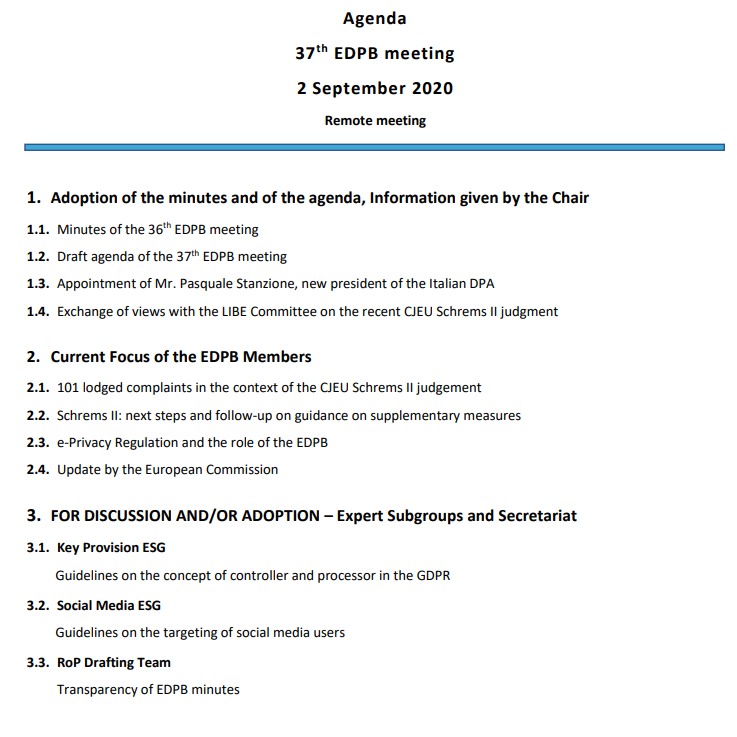
(more…)- Adoption of the minutes and of the agenda, Information given by the Chair
- Minutes of the 36th EDPB meeting
- Draft agenda of the 37th EDPB meeting
- Appointment of Mr. Pasquale Stanzione, new president of the Italian DPA
- Exchange of views with the LIBE Committee on the recent CJEU Schrems II judgment
- Current Focus of the EDPB Members
- 101 lodged complaints in the context of the CJEU Schrems II judgement
- Schrems II: next steps and follow-up on guidance on supplementary measures
- e-Privacy Regulation and the role of the EDPB
- Update by the European Commission
- FOR DISCUSSION AND/OR ADOPTION – Expert Subgroups and Secretariat
- Key Provision ESG
Guidelines on the concept of controller and processor in the GDPR - Social Media ESG
Guidelines on the targeting of social media users - RoP Drafting Team
Transparency of EDPB minutes - Strategic Advisory ESG
- EDPB strategic plan: draft paper and possible seminar
- Secretariat
- Art. 65 procedure
- Legal studies
- Key Provision ESG
- Any other business



Copyright © 2026 All rights reserved.
Designed by 