
With the Brexit transition period ending on 31 December 2020, and no deal in sight, the future of cross-border data transfers between the European Economic Area (the EEA) and the United Kingdom remains unclear. On 1 January 2021, the United Kingdom will be considered as a “third country” and, unless a Brexit deal is proposed dealing with data protection and how data transfers between the EEA and the United Kingdom are to be treated, it could be significantly more difficult for European Union (EU)-based entities to transfer personal data to the United Kingdom.
(more…)GDPR/Brexit – What Future For UK-EU Data Flows
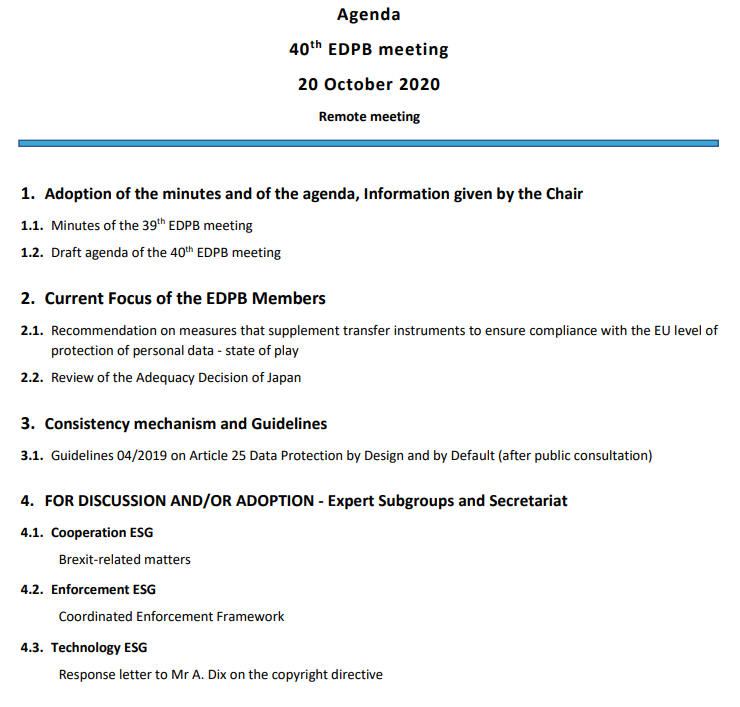
October 29th, 2020 | Posted by in Data Transfer | Europe | Privacy - (0 Comments)- Adoption of the minutes and of the agenda, Information given by the Chair
1.1. Minutes of the 39 th EDPB meeting
1.2. Draft agenda of the 40th EDPB meeting - Current Focus of the EDPB Members
2.1. Recommendation on measures that supplement transfer instruments to ensure compliance with the EU level of protection of personal data – state of play
2.2. Review of the Adequacy Decision of Japan - Consistency mechanism and Guidelines
3.1. Guidelines 04/2019 on Article 25 Data Protection by Design and by Default (after public consultation) - FOR DISCUSSION AND/OR ADOPTION – Expert Subgroups and Secretariat
4.1. Cooperation ESG Brexit-related matters
4.2. Enforcement ESG
Coordinated Enforcement Framework
4.3. Technology ESG
Response letter to Mr A. Dix on the copyright directive1
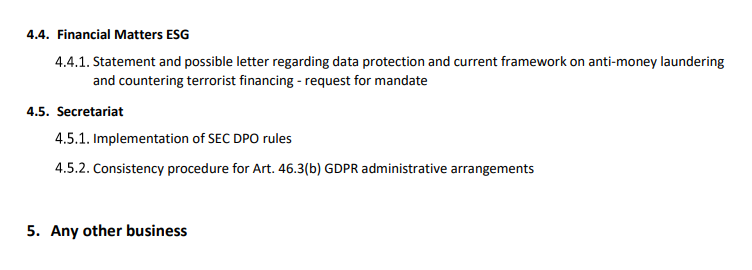
4.4. Financial Matters ESG
Statement and possible letter regarding data protection and current framework on anti-money laundering and countering terrorist financing – request for mandate
4.5. Secretariat
Implementation of SEC DPO rules
Consistency procedure for Art. 46.3(b) GDPR administrative arrangements - Any other business
🇺🇸 The Future of Work in a Post-COVID-19 Work Environment
October 16th, 2020 | Posted by in Conference - (0 Comments)We are currently experiencing an interesting time in our economy around the future of work. In describing the future of work, there are four main aspects that come into play: (i) People will be able to work remotely and with flexible schedules; (ii) New industries and jobs will be created complementary to technology; (iii) There will be more entrepreneurship and self-employment; and (iv) Due to technology advancements, there will be fewer jobs that require humans.
Against this backdrop, the COVID-19 outbreak pointed out that these new working norms are going to become the future. In fact, more and more companies wonder whether people can work effectively and achieve a level of work-life balance in light of these new working conditions. At the same time, there is considerable research showing that diversity can be the answer to these considerations, leading to a significant performance advantage.
As law firms around the world have been forced into an unplanned experiment with remote and flexible working, the webinar will aim to explore what the new COVID-19 reality means for the workforce and how can they embrace the pandemic’s opportunities for learning and thriving in the workplace.
Leaders League Ranking 2020 – Health, pharma & biotechnology – E-Health – France
October 2nd, 2020 | Posted by in eHealth | France | IT | Privacy | Rankings - (0 Comments)GDPR/ePrivacy – French Supervisory Authority Publishes Updated Guidance on Cookies and Other Tracing Technologies
October 1st, 2020 | Posted by in Privacy - (0 Comments)Following the French Administrative Supreme Court (Conseil d’État) dated 19 June 2020 (see our Alert here), the French Supervisory (CNIL) published on 01 October 2020 its updated guidelines (the Guidelines), replacing its former guidelines published on 04 July 2019 (July Guidelines), along with practical recommendations (the Recommendation) on cookies and other tracking technologies (together, Cookies).
(more…)

Copyright © 2026 All rights reserved.
Designed by 