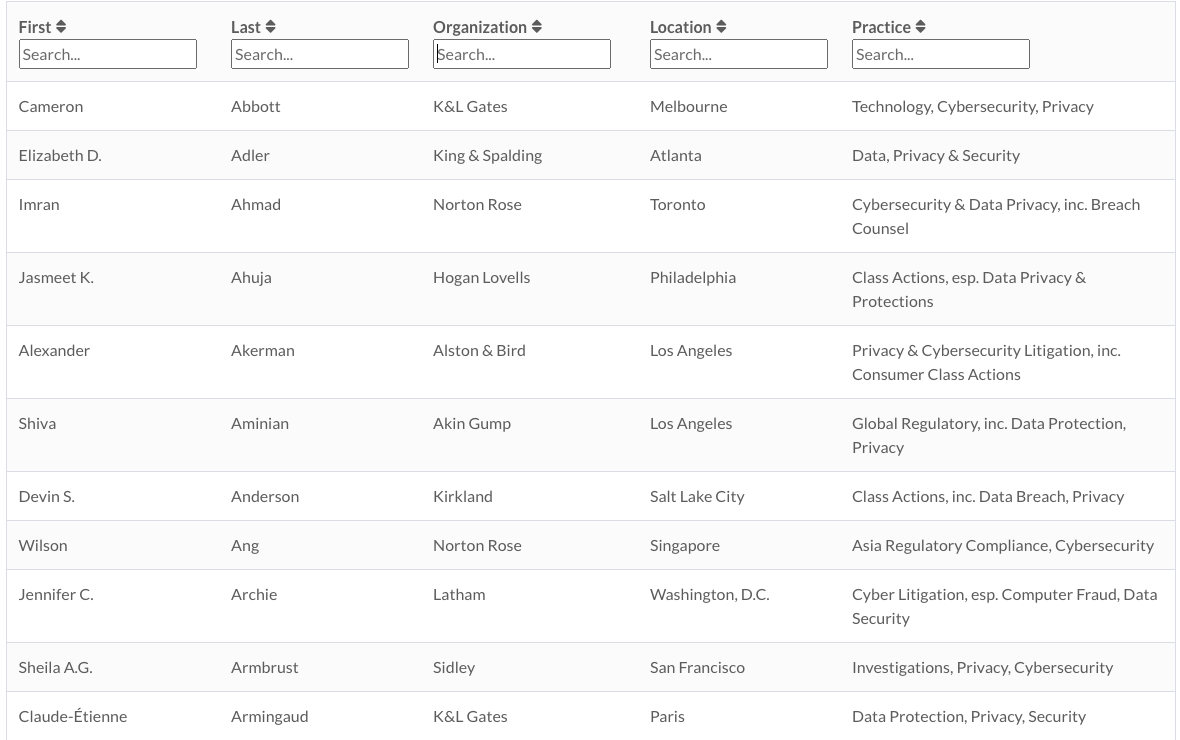
We are thrilled to share our newest guide – and honor the 500 global cyber lawyers recognized here.

There is little in life or law that isn’t encoiled in the digital world these days. And these are the lawyers who connect it all – data and security, innovation and inspiration, litigation and exploration.

Defining what exactly a leading cyber lawyer is was part of the mission. The core of this guide are the privacy and data security specialists who began forming this practice well over a decade ago as companies experienced data breaches and attorneys scurried to become designated as privacy specialists.

But a deep dive on what lawyers and firms globally consider to be cybersecurity these days uncovered a world robust with former intelligence officers, hackers, government officials learning to parse competition claims regarding data sets, tech dealmakers turned to for their way around cyber protocols as deal points, litigators who defend Big Tech from claims of biometric privacy invasion. Robustly represented are former prosecutors and other government leaders whose portfolios detail vast experience in cyber crime security and prosecution.

Take TikTok as an example of the vast layers of legal regulation, national security, technology and consumer protection embedded in its affairs. We’re fascinated to watch the legal teams assemble to parse demands it be sold.

Specialists in regulation of drones and autonomous vehicles are represented here, alongside the legal world’s leading minds in national security, who guide on often old battles fought with new weapons.

To create this list – our inaugural edition – we weighed nominations, independent research and views of peers. This guide is 39 percent female and 19 percent inclusive. Those noted by an asterisk are esteemed members of our Hall of Fame

Source: LawDragons

K&L Gates’s expertise in data and tech work has recently seen it advise on matters as diverse as AI and machine learning projects’ impact on personal data retention and transparency and the implications of augmented reality make-up applications and smart fragrances. While the firm has some significant tech companies on board, the client base skews more heavily towards advising more traditional industries through digital transformation.
The data protection, privacy and security practice has multiple leaders, reflecting its wide geographic spread.
Claude-Étienne Armingaud in Paris, who is a dual-qualified French and New York lawyer, is a stand-out name: besides GDPR and privacy compliance, he also has extensive experience advising on tech transactions, for example relating to software, blockchain, connected cars and more. Other partners leading the practice are Cameron Abbott in Melbourne; Shannan Frisbie, Whitney McCollum, David Bateman and Carley Andrews in the firm’s Seattle headquarters; Bruce Heiman in Washington, DC; Limo Cherian in Chicago; Gina Bertolini and Leah Richardson in the Research Triangle Park office in North Carolina; and Sarah Turpin in London.

The K&L Gates practice’s senior ranks grew with the addition of San Francisco partner Michael Stortz, who was formerly at Akin Gump. Thomas Nietsch was promoted to the partnership in Berlin. The firm also hired counsel Veronica Muratori in Milan from Withersworldwide; Avril Love in Los Angeles from Tucker Ellis; and Ulrike Elteste in Frankfurt from Covington & Burling.

Client references


“K&L Gates has deep expertise and knowledge in this area and is always responsive. Advice is always timely and well-considered.”


“Collaboration with K&L Gates is always seamless. The team have deep knowledge of privacy laws and regulations, but they also understand the business impact of their advice. This sets them apart from other firms in the market.”

First publication: Lexology GDR100

A Practice Note highlighting issues to consider when counseling a prospective buyer of an AI company. This Note discusses the primary due diligence issues relating to AI and machine learning (ML) and strategies to mitigate or allocate risks in the context of an M&A transaction. This Note is also helpful for AI company targets that seek to anticipate potential issues. In this Note, the term AI company refers to a company involved in the research, development, or monetization of a product or service that is primarily powered by an ML algorithm or model that creates functionality or utility through the use of AI.

Read the full article on Practical Law, written in collaboration with by Annette Becker, Alex V. Imas, Jake Bernstein, Mark H. Wittow, Melanie Bruneau, Marion Baumann, Kenneth S. Knox, Julie F. Rizzo, Cameron Abbott, Thomas Nietsch, and Nicole H. Buckley.